Sumo Show vs. Grand Tournament
Sumo show or Grand Sumo Tournament? Compare cost, availability, authenticity and what you'll actually see, so you book the right one for your trip.
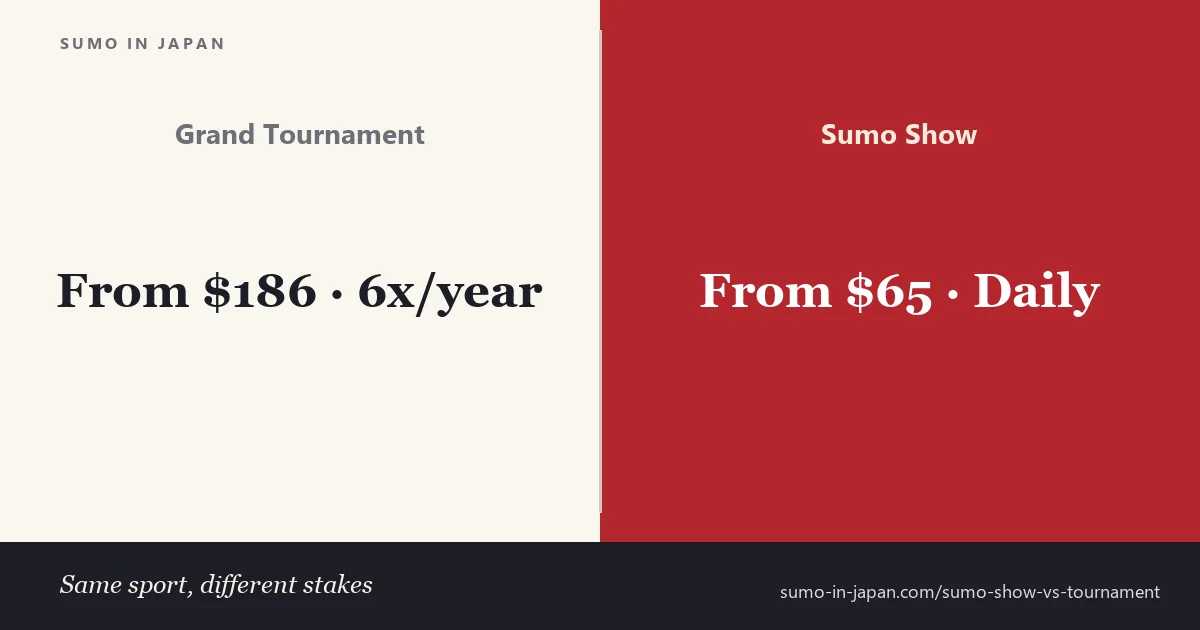
“Sumo show” and “sumo tournament” get used almost interchangeably in trip-planning searches, but they’re genuinely different products — different venues, different price points, and a different relationship to the sport’s actual ranking system. Confusing the two is the single most common way travelers end up disappointed with a sumo booking: expecting the pageantry and crowd energy of a live honbasho and getting a smaller demonstration venue, or expecting a same-day walk-in show and finding out the only option that week is a sold-out tournament. Here’s exactly how they differ, so you book the one that matches what you actually want to see.
The short answer
A Grand Sumo Tournament (honbasho) is the real, professionally ranked competition — held only six times a year, 15 days each, rotating between Tokyo, Osaka, Nagoya, and Fukuoka. Top-division wrestlers are competing for actual promotion or demotion; nothing about the outcome is staged. A sumo show is a year-round entertainment program at a dedicated venue — current or former wrestlers perform live sparring and rituals for a paying audience, with a host explaining what you’re watching, but no ranking is on the line. Both are genuine sumo performed by genuine wrestlers. The difference is competitive stakes and, as a direct result, availability.
Side-by-side comparison
| Grand Sumo Tournament | Sumo Show | |
|---|---|---|
| Is the outcome real/competitive? | Yes — determines wrestler rank | No — demonstration format |
| Availability | Only 6x/year, 15-day windows, in rotating cities | Daily, year-round |
| From (this site) | $186 | $65 |
| Typical duration | Full match day; guided portion ≈2–3 hrs plus seated time | Under 90 min – 2 hrs |
| Venue | National arenas (Ryogoku Kokugikan, EDION Arena Osaka, IG Arena, Fukuoka Kokusai Center) | Dedicated show venues (e.g. Shinjuku, Tokyo) |
| Ceremony/ritual | Full dohyo-iri ring-entering ceremony, Yokozuna ceremony (when a grand champion competes) | Ritual elements demonstrated and explained, shorter format |
| Can I try it myself? | No — spectator only | Often yes — optional volunteer challenge against a wrestler |
| Dining option | Not typically included | Chanko-nabe lunch included on several show tours |
| Advance planning | High — book weeks ahead, especially weekends/final days | Low — book any day, fixed show times |
Book the Right Sumo Experience
Ready to book? Whether you’re leaning toward a Grand Sumo Tournament at Ryogoku Kokugikan in Tokyo, a year-round sumo show in Shinjuku or Ginza, morning stable practice in Ryogoku, or a hands-on sumo lesson in Kawasaki, the options below cover everything currently available with free cancellation on most bookings.
What you’ll actually see at each
At a tournament, you’re one of roughly 8,000–17,000 spectators (venue-dependent) inside a real sporting arena on a match day. The afternoon builds toward the top-division (Makuuchi) bouts, preceded by the dohyo-iri — a ceremonial procession where top-ranked wrestlers enter the ring in ornate aprons — and, on days a Yokozuna (grand champion) is competing, a separate entrance ceremony just for them. Between individual bouts, wrestlers perform the salt-throwing purification ritual and the shiko leg-stomp. None of this is choreographed for tourists; it’s the same ceremony that’s run before every professional bout for centuries.
At a show, you’re in a smaller, dedicated venue built specifically for demonstration performances. An English-speaking MC walks you through the sport’s history and rituals in real time as current or former wrestlers demonstrate live sparring — the same techniques and much of the same ritual vocabulary (salt-throwing, shiko), just performed outside a competitive bracket. The format is built around audience engagement: most shows end with an open invitation for volunteers to step into the ring for a lighthearted, safety-supervised bout against a wrestler, something that’s simply not part of a tournament seat at any price.
Cost and why the gap is that wide
Tournament tickets on this site start around $186; the flagship sumo show starts around $65. That’s not a markup on the same product — it reflects two different cost structures. A tournament ticket includes admission to an actual professional sporting event with a real, sanctioned seating allocation inside a national arena, on one of only 90 tournament days a year across the whole country (six 15-day bashos). A show ticket is entry to a private, purpose-built venue that runs multiple performances a day, every day — closer in cost structure to a theater ticket than a stadium sporting event.
Which one should you book?
Choose the tournament if:
- Your travel dates land inside one of the 2026 honbasho windows
- You want to see genuinely competitive sport, not a demonstration
- You don’t mind a longer, more spectator-format afternoon (seated, no participation)
- You’re comfortable booking a few weeks ahead for the best seat selection
Choose the show if:
- Your trip dates don’t land inside a tournament window (this covers most of the year)
- You want the option to physically step into the ring yourself
- You’re traveling with kids — shows run a livelier, more interactive format and several operators offer family pricing
- You want a shorter time commitment (under 2 hours vs. a full match-day afternoon)
- You want chanko-nabe dining bundled into the same booking
If you’re still unsure, our homepage comparison table lines up all four sumo experience formats — tournament, show, morning practice, and hands-on lesson — side by side on price, availability, and “best for,” which is worth a look if a show or tournament both sound appealing and you want to see morning practice and lessons in the same view before deciding.
A note on authenticity
It’s worth being direct about a common misconception: a sumo show isn’t a “fake” or watered-down tournament — it’s a different, equally legitimate product built for a different purpose. Wrestlers performing in shows are frequently working or former professionals from real stables, and the techniques, rituals, and history explained are entirely accurate. What you’re trading isn’t authenticity for spectacle; you’re trading competitive stakes and arena scale for year-round availability, a shorter time commitment, and — on most shows — the chance to actually participate rather than just watch.
Ready to Book?
Ready to pick one? Browse Grand Sumo Tournament tickets if your dates line up with the 2026 calendar, or the Shinjuku sumo show with chanko-nabe dining for a year-round option — or compare all four formats on the homepage.
Ready to See Sumo in Japan?
Compare tournament tickets, sumo shows, morning practice, and hands-on lessons — verified operators, real reviews, free cancellation on most experiences.
Explore Sumo Experiences